Biodegradable Packaging vs. Monomaterial Films: A Sustainability Trade-Off Guide
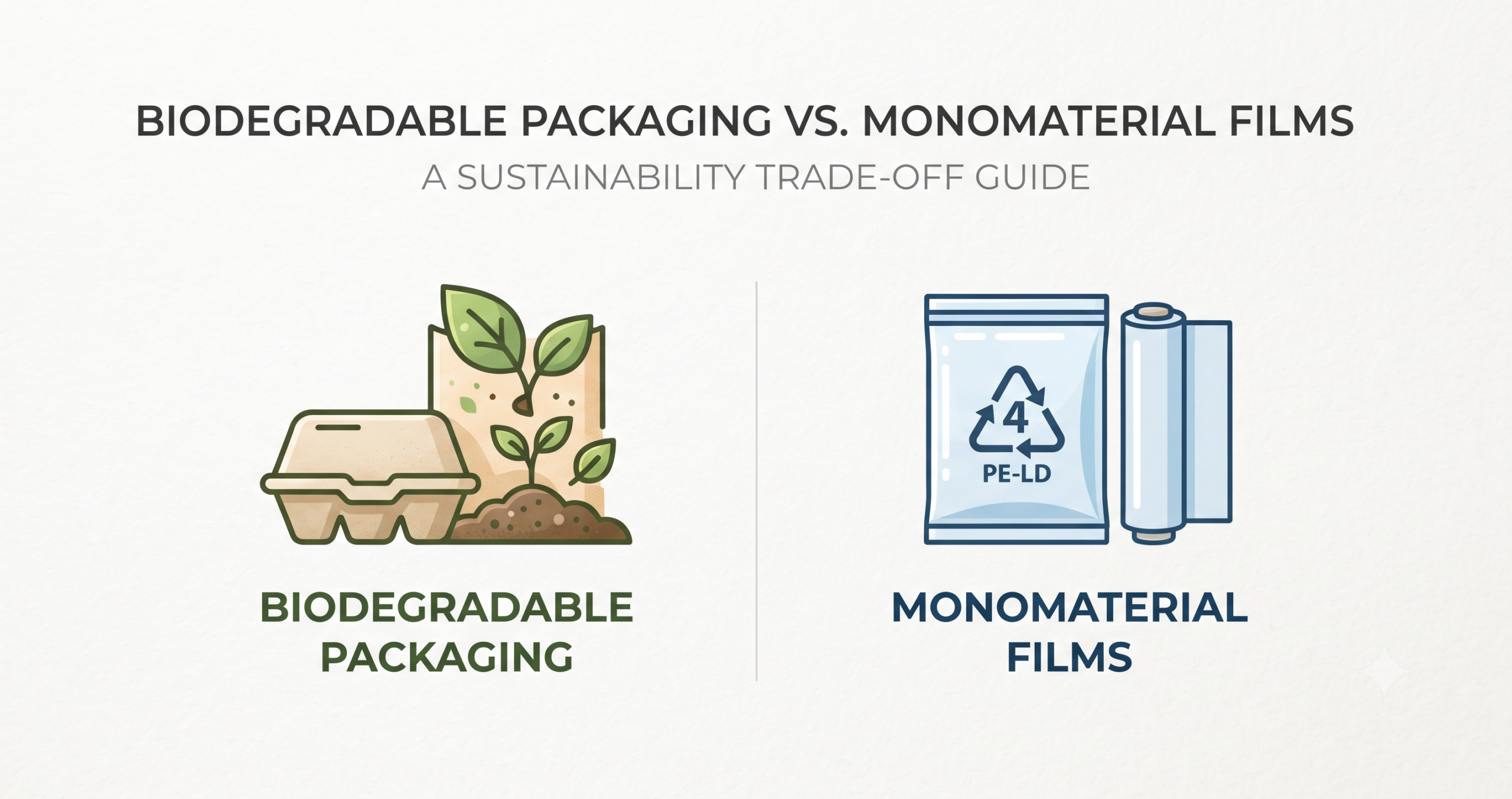
Flexible-packaging converters are under growing pressure to offer sustainable packaging solutions without compromising shelf life, machinability, or cost. Two approaches dominate the conversation: biodegradable packaging materials and monomaterial flexible packaging. They are often discussed interchangeably, but they solve different problems and fit different production lines. This guide breaks down how each works, where each performs best, and how to decide which direction fits your operation.
What Is Biodegradable Packaging?
Biodegradable packaging is designed to break down through biological processes — typically via microbial activity — under specific conditions (industrial composting, home composting, or soil/marine environments, depending on the certification standard used). Common substrates include PLA (polylactic acid), PBAT blends, and cellulose-based films.
The key word is conditions. A film’s biodegradability is only meaningful in the environment it was tested and certified for. A film certified for industrial composting will not necessarily break down in a home compost bin or a landfill, and claims should always be tied to the specific certification and test standard behind them rather than presented as a general environmental benefit.
Where biodegradable films tend to fit well:
- Single-use sachets and pouches for food service where composting infrastructure exists
- Applications where end-of-life recovery through recycling streams is impractical
- Brands whose end markets have accessible industrial composting facilities
Trade-offs to plan for:
- Barrier performance (oxygen, moisture) can lag behind conventional films unless engineered with additional layers or coatings
- Sealing and converting parameters often differ from standard PE/PP lines and may need line trials
- Availability of composting infrastructure varies significantly by region
What Are Monomaterial Films?
Monomaterial flexible packaging is built from a single polymer family (for example, all-PE or all-PP structures) instead of mixing polymer types in a laminate. The goal isn’t biological breakdown — it’s making a package easier to sort and reprocess within existing plastic recycling streams, since mixed-polymer laminates are difficult for recyclers to separate.
Where monomaterial films tend to fit well:
- Products sold in regions with established PE or PP recycling collection and sorting infrastructure
- Converters looking to reduce structure complexity without a complete equipment overhaul
- Categories where recyclability labeling and take-back programs are a purchasing consideration
Trade-offs to plan for:
- Achieving equivalent barrier and stiffness properties within a single polymer family can require specialized resins or coatings
- Recyclability in practice depends on local collection and sorting systems actually accepting the structure
- Sealant layer selection matters more, since there’s no dissimilar polymer to fall back on for seal strength
Biodegradable vs. Monomaterial: Side-by-Side
| Factor | Biodegradable Films | Monomaterial Films |
| End-of-life pathway | Composting (industrial/home, per certification) | Mechanical recycling (where infrastructure exists) |
| Barrier performance | Often needs added layers/coatings to match conventional films | Achievable with the right resin/coating selection |
| Infrastructure dependency | Requires composting facilities | Requires plastics recycling collection/sorting |
| Typical categories | Food service sachets, compostable pouches | Snack packaging, pouches, wraps |
| Claim sensitivity | Must cite specific certification and test standard | Must confirm local recyclability, not a blanket claim |
How to Choose for Your Line
- Start with where the package will be sold and disposed of. A monomaterial structure is only meaningfully recyclable if your end market has the collection infrastructure to process it. A biodegradable structure is only meaningfully compostable if industrial or home composting is genuinely accessible there.
- Check your barrier requirements against the base resin. High-moisture or high-oxygen-barrier products may need a coated or multi-layer version of either approach — get technical data sheets for the specific grade, not the polymer family in general.
- Run a line trial before committing volume. Sealing temperatures, tension settings, and print adhesion can differ from your current structures.
- Verify any sustainability claim against its actual certificate. Match the claim to the specific product grade and facility, not the category as a whole.
Where Junish Fits
Junish sources flexible-packaging films, aluminium foil, and specialty materials — including sustainable-solution substrates — from a global network of manufacturers, and helps converters match the right structure to their line and end-market requirements. Rather than manufacturing a single fixed range, Junish’s role is to source the specific grade that fits your barrier, sealing, and end-of-life requirements, backed by manufacturer-specific technical documentation.
FAQs
Is biodegradable packaging always better for the environment than monomaterial film?
Not necessarily — it depends on whether your product’s end market has composting infrastructure (for biodegradable) or plastics recycling infrastructure (for monomaterial). Neither option is automatically the better choice; the right one depends on where the package is actually used and disposed of.
Can monomaterial films match the barrier performance of multi-layer laminates?
In many cases, yes, with the right resin selection or added coatings — but this should be confirmed against the technical data sheet for the specific grade, since performance varies by supplier and formulation.
Do biodegradable films cost more than conventional flexible packaging?
Typically, yes, though the gap varies by resin type, volume, and region. It’s worth comparing landed cost against a specific conventional alternative rather than assuming a fixed premium.
How do I know if a sustainability claim on a film is valid?
Ask for the specific certification (such as an industrial compostability or recyclability certificate) tied to the exact product grade and manufacturing facility — not a general claim about the polymer category.