BOPP vs. PET Labels: Choosing the Right Film Substrate for Your Packaging
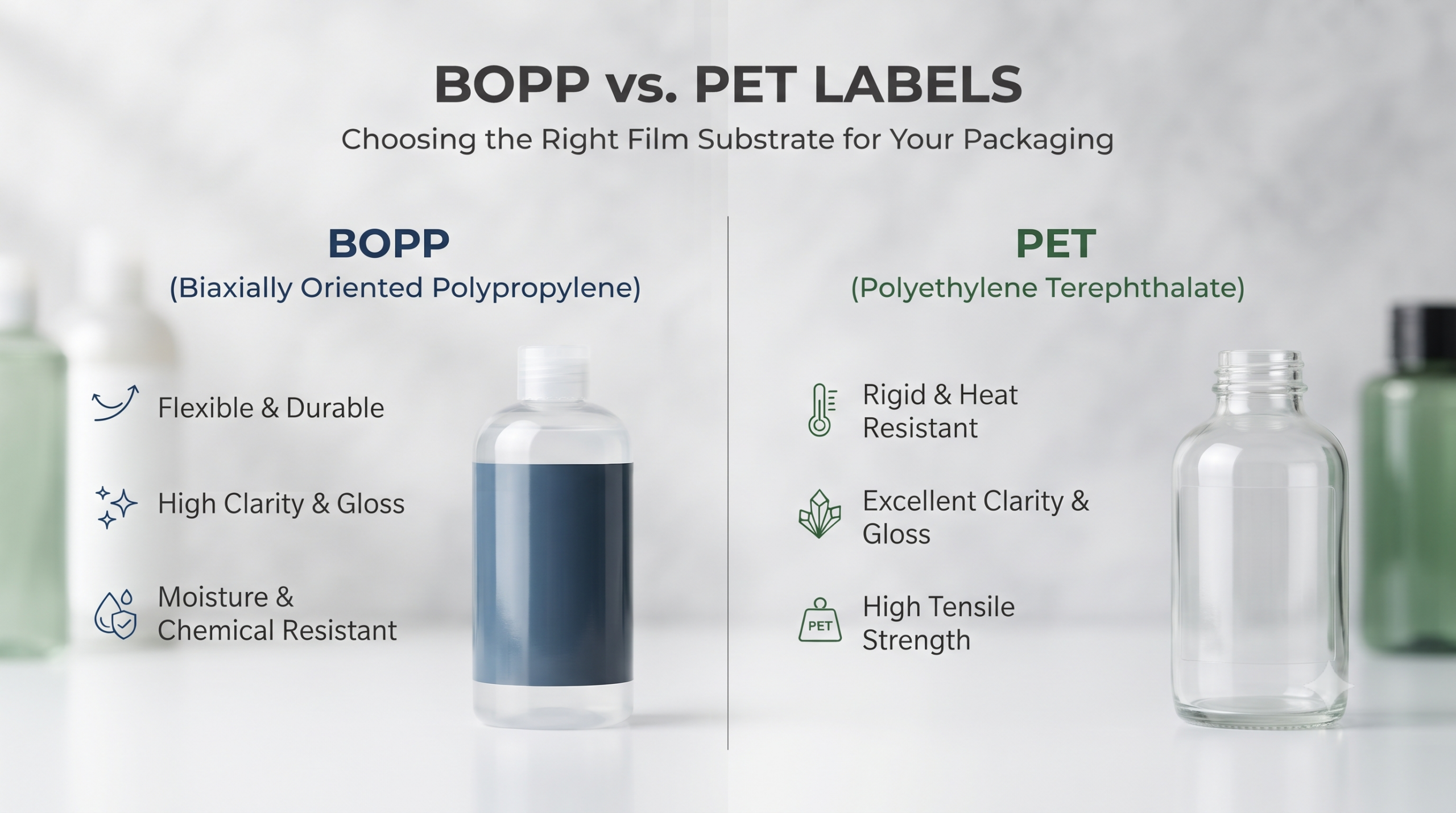
Choosing between BOPP labels and PET labels affects more than just how a label looks on the shelf — it affects durability, moisture resistance, print performance, and cost per unit. Both are widely used pressure-sensitive label substrates, but they perform differently depending on the product, application environment, and label finish you need. Here’s how to tell them apart and choose the right one.
What Is BOPP Film?
BOPP (Biaxially Oriented Polypropylene) is a lightweight, cost-efficient film available in clear, white, and metallized finishes. It’s the most widely used label substrate for everyday packaged goods because it balances cost, print quality, and moisture resistance well.
Typical strengths:
- Lower cost per label compared to PET
- Good moisture resistance for standard shelf conditions
- Available in a wide range of finishes (gloss, matte, metallized, clear “no-label look”)
- Suitable for a broad range of standard labeling applications
Where it’s commonly used: beverage labels, personal care products, household goods, and food packaging that doesn’t require extreme durability.
What Is PET Film?
PET (Polyethylene Terephthalate) is a denser, higher-clarity film with greater tensile strength, dimensional stability, and resistance to temperature extremes and chemical exposure than BOPP.
Typical strengths:
- Higher clarity for a premium, glass-like “no-label look”
- Better dimensional stability under temperature and humidity swings
- Stronger resistance to oils, chemicals, and abrasion
- Better suited to conditions involving refrigeration, freezing, or repeated handling
Where it’s commonly used: premium beverage and spirits labels, industrial and chemical drum labels, cosmetics, and products exposed to moisture, cold storage, or rough handling.
BOPP vs. PET: Side-by-Side
| Factor | BOPP Labels | PET Labels |
| Cost | Generally lower | Generally higher |
| Clarity | Good | Excellent (glass-like clarity available) |
| Durability | Suitable for standard conditions | Higher resistance to chemicals, abrasion, temperature extremes |
| Dimensional stability | Moderate | High — holds up better under humidity/temperature swings |
| Common finish | Gloss, matte, metallized, clear | Clear, high-gloss, metallized |
| Typical use case | Everyday packaged goods, beverages, personal care | Premium products, cold-chain, chemical/industrial labeling |
Choosing Between BOPP and PET for Your Labels
- Check the storage and handling environment. If the product goes through refrigeration, freezing, high humidity, or rough transport, PET’s dimensional stability and durability generally hold up better.
- Factor in shelf positioning. If a premium, glass-like clear look is the priority and the product sits in standard ambient conditions, BOPP’s clear finish is often a cost-effective way to get a similar shelf appearance.
- Consider chemical or moisture exposure. Products like cleaning agents, industrial chemicals, or anything with condensation exposure benefit from PET’s chemical and moisture resistance.
- Balance cost against run volume. For high-volume, standard-condition applications, BOPP’s lower cost per label typically makes it the more efficient choice; PET’s premium is easier to justify for lower-volume, higher-durability-need applications.
- Confirm printability with your specific press setup. Both substrates run on flexo, offset, and digital label presses, but ink adhesion and coating requirements vary by supplier and grade — check the technical data sheet before committing to a run.
Where Junish Fits
Junish sources BOPP and PET label-grade films from a global network of manufacturers, helping converters match the right substrate, finish, and grade to their specific labeling application — backed by manufacturer-specific technical data sheets rather than general category claims.
FAQs
Is PET always better than BOPP for labels?
Not always — it depends on the application. PET generally performs better in demanding conditions (cold chain, chemical exposure, rough handling), while BOPP is a cost-efficient, well-performing choice for standard ambient-condition labeling.
Which film gives a better “no-label look”?
Both are available in high-clarity clear formats, but PET typically offers a slightly higher glass-like clarity. BOPP’s clear grades are a common, more cost-effective alternative for the same visual effect in standard conditions.
Can BOPP labels handle refrigerated or frozen products?
BOPP can handle moderate refrigeration in many applications, but for freezer conditions or repeated temperature cycling, PET’s dimensional stability generally provides more consistent performance — this should be confirmed against the specific grade’s technical data sheet.
Does label substrate choice affect adhesive selection?
Yes — adhesive compatibility depends on the specific film grade and finish, as well as the container material and storage conditions. It’s best to confirm adhesive and substrate combinations with your supplier for the exact application before running production volumes.
Related Blogs
No related posts found.