Indian Aluminium Foil: An Emerging Strategic Supply Origin
India’s upstream scale, growing foil platform and export footprint make it increasingly relevant to global flexible packaging. Supplier qualification, carbon transparency and responsible structure design will decide how far that relevance travels.
India is becoming a serious strategic supply origin for aluminium foil in flexible packaging. This Junish analysis examines the production, export, quality, carbon and sourcing facts global buyers should understand.
The sourcing question has changed
Price alone no longer decides where global flexible-packaging buyers source aluminium foil.
For many applications, foil remains a critical barrier material. It helps protect products from light, oxygen, moisture, aroma loss and contamination. The purchasing decision has widened well beyond gauge, alloy, temper, conversion premium and freight. Buyers must also consider supply concentration, country-of-origin risk, trade remedies, working-capital exposure, quality consistency, carbon reporting, food-contact compliance, recyclability expectations and the resilience of the complete packaging structure.
This is the context in which India’s aluminium foil industry is becoming strategically relevant.
The evidence does not support the claim that India will simply replace China, Europe or other established supply bases. China remains far larger in global aluminium foil exports. In 2024, China exported approximately US$5,700.2 million and 1.556 million metric tonnes (3,429.9 million lbs) of aluminium foil across HS 760711, HS 760719 and HS 760720. India exported approximately US$247.3 million and 53.6 thousand metric tonnes (118.1 million lbs) across the same three headings. On that basis, China’s export value was approximately 23.1 times India’s. [1-6]
A resilient global flexible-packaging sourcing strategy increasingly needs to evaluate, qualify and maintain Indian-origin aluminium foil as part of a diversified supply architecture.
India has the base to participate
India’s Ministry of Mines lists total existing primary aluminium capacity at 4.303 million metric tonnes (9,486.5 million lbs), with FY2025-26 production of 4.257 million metric tonnes (9,385.1 million lbs), led by NALCO, BALCO, Hindalco and Vedanta. [7]
Primary aluminium production is not the same as foil-rolling capacity. Producing high-quality converter foil, especially at ultra-light gauges, requires specialised rolling, metallurgy, filtration, annealing, surface control, slitting and quality-management systems.
But the upstream base matters. It gives India the industrial foundation from which downstream rolling, foil conversion, technical personnel, supply-chain infrastructure and investment confidence can grow. India is not trying to build a foil-export story without a metal base behind it.
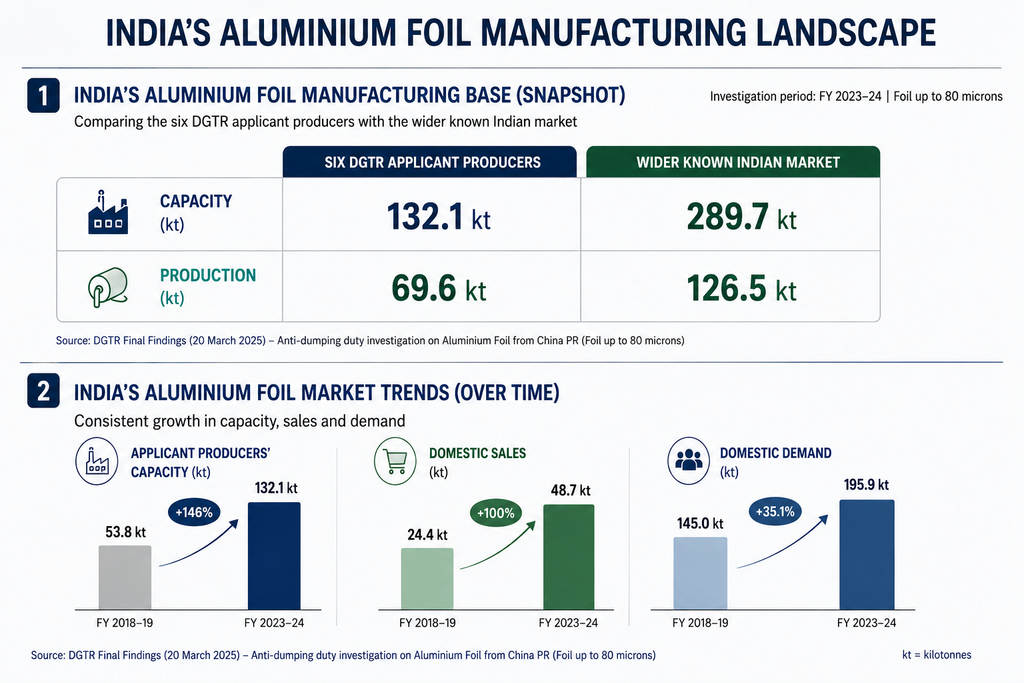
The DGTR investigation covered aluminium foil up to 80 microns, subject to specified exclusions, and the period of investigation was 1 October 2022 to 30 September 2023. This scope matters. The figures should not be described as the totality of all Indian flexible-packaging foil activity without that qualification. [8]
Within that defined scope, DGTR recorded six applicant producers: Hindalco Industries, Shyam Sel & Power, Shree Venkateshwara Electrocast, Ravi Raj Foils, GLS Foils Products and LSKB Aluminium Foils. DGTR recorded their combined capacity at 132.1 thousand metric tonnes (291.3 million lbs), and their combined production at 69.6 thousand metric tonnes (153.4 million lbs), for product under consideration and non-product-under-consideration together. DGTR also recorded known Indian capacity of 289.7 thousand metric tonnes (638.8 million lbs), and known Indian production of 126.5 thousand metric tonnes (278.9 million lbs). [8]
The expansion trend is significant. Among the six applicants, capacity increased from 53.8 thousand metric tonnes (118.5 million lbs) in 2019-20 to 132.1 thousand metric tonnes (291.3 million lbs) in the investigation period. Production of product-under-consideration and on-product-under-consideration together increased from 27.8 thousand metric tonnes (61.4 million lbs) to 69.6 thousand metric tonnes (153.4 million lbs). Product-under-consideration-only production increased from 26.8 thousand metric tonnes (59.1 million lbs) to 66.4 thousand metric tonnes (146.3 million lbs). Domestic sales increased from 24.4 thousand metric tonnes (53.7 million lbs) to 48.7 thousand metric tonnes (107.3 million lbs). [8]
Demand in India for the investigated product increased from 145.0 thousand metric tonnes (319.6 million lbs) in 2019-20 to 195.9 thousand metric tonnes (431.8 million lbs) in the investigation period. That represents growth of approximately 35.1%. Imports from China increased from 21.8 thousand metric tonnes (48.1 million lbs) to 61.5 thousand metric tonnes (135.7 million lbs), and China’s share of Indian demand increased from 15% to 31%. [8]
Together, these figures describe a multi-producer industry with real export potential. It has moved well past a single-supplier, domestic-only story.
At the same time, capacity is not the same as immediate qualification. A mill may have capacity in one alloy, gauge, width, surface condition or application that cannot automatically be substituted into another. For global flexible-packaging buyers, supplier qualification must still happen at the level of the mill, machine, alloy, temper, gauge, width, surface, converting process and final application.
This is particularly important because the DGTR record also included concerns raised by some downstream users regarding cost, quality, lead times and implications for flexible packaging, food and pharmaceutical applications. DGTR did not accept those objections as sufficient to defeat the domestic industry’s case on the investigation record, but the presence of those objections reinforces a practical point: every serious buyer still needs application-specific validation. [8]
India already has international reach
Capacity proves potential. Exports prove the commercial channels already exist.
World Bank WITS data, sourced from UN Comtrade, puts India’s 2024 exports across the three principal foil headings at:
| HS code | Description | 2024 export value | 2024 export volume | Leading destinations |
| 760711 | Rolled aluminium foil, not backed | US$53.9 million | 13.3 thousand MT (29.3M lbs) | US, Italy, Bangladesh, Poland, Spain |
| 760719 | Other aluminium foil, not backed | US$121.5 million | 26.7 thousand MT (58.8M lbs) | US, Italy, Bangladesh, Netherlands, Nepal |
| 760720 | Aluminium foil, backed | US$71.8 million | 13.6 thousand MT (30.0M lbs) | Bangladesh, Egypt, UAE, US, Mexico |
Together, that is approximately US$247.3 million and 53.6 thousand metric tonnes (118.1 million lbs), up about 12.4% on 2023’s US$219.9 million. [4-6, 9-11] Indian-origin foil is already moving through trade lanes across North America, Europe, South Asia, the Middle East, Africa and Latin America.
Export activity shows reach; it does not prove packaging qualification. HS 7607 covers foil up to 0.2 mm across both packaging and non-packaging uses, and export value shifts with metal prices and exchange rates too. Treat these figures as evidence of scale and geography, not as a measure of flexible-packaging qualification.
Sourcing has become a risk-adjusted decision
Foil sourcing used to be a cost exercise: metal price, conversion premium, freight, credit terms. Origin exposure, duties, regulatory risk and supplier stability now move the true landed cost as much as the invoice does.
India’s own trade-remedy action illustrates how origin-specific exposure can become commercially material. In June 2025, India issued Notification No. 15/2025-Customs (ADD), imposing definitive anti-dumping duties on specified aluminium foil up to 80 microns originating in or exported from China, subject to the notification’s tariff classifications, product descriptions and exclusions. The notification states that the duty is effective for five years from 17 March 2025, unless revoked, amended or superseded earlier. [12]
This does not mean Indian foil automatically has a tariff advantage in every export market. It does not mean duties are the same in every destination. It does not mean every Chinese-origin product is commercially unviable. Classification, origin, product description, producer status and destination-country rules must all be checked case by case.
The broader lesson is that foil sourcing has become a risk-adjusted decision.
Metal price + conversion premium + freight + duty exposure + inventory carrying cost + safety stock + quality yield + line efficiency + documentation burden + carbon reporting + probability and cost of disruption.
The procurement objective is a supplier who delivers the required performance consistently, at an acceptable total cost, with the documentation and continuity the application demands.
Foil is not interchangeable
The strongest case for Indian foil will be won on consistent technical performance, not national origin.
ASTM B479 covers annealed aluminium foil for flexible barrier and food-contact use, spanning 0.0064 mm to just under 0.15 mm in alloys including 1235, 8011 and 8079. [13] Those are the exact alloys Junish’s own ultra-light-gauge foil produce: 8079, 8011 and 1235, at 0.006-0.007 mm, in widths from 200 mm to 2.1 metres. [14]
A lower-gauge foil is only an improvement if the package still performs. As gauge drops, pinhole risk rises; ASTM B926 sets out a light-table method for finding and counting them. [15] Done well, downgauging is genuinely valuable, both commercially and environmentally, provided it is treated as an engineering decision rather than a material-reduction shortcut.
There is no credible universal pinhole limit, bond-strength value or tensile specification that applies to every flexible-packaging foil application. The correct specification depends on the packed product, laminate design, converting process, filling line, distribution environment and required shelf life.
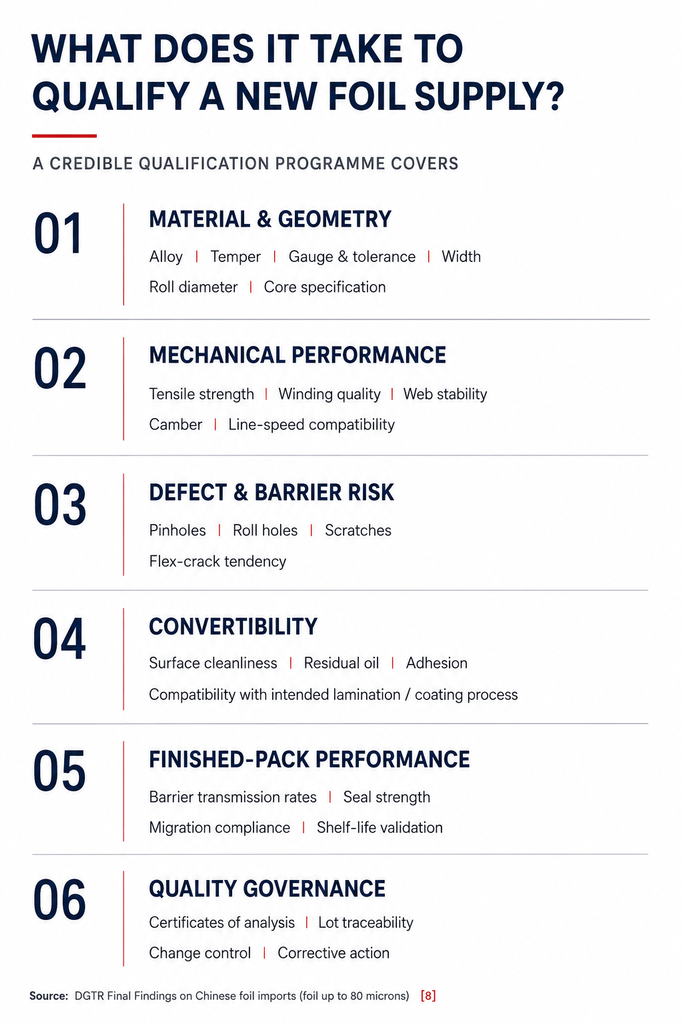
Qualification should cover at least six areas:
- Material identity and geometry: alloy, temper, chemistry, gauge, gauge tolerance, width, width tolerance, roll diameter, core specification and roll geometry.
- Mechanical and handling performance: tensile properties, elongation, winding quality, edge condition, web stability, splice quality, wrinkles, telescoping, camber and suitability for the converter’s line speed.
- Defect and barrier risk: pinholes, roll holes, scratches, inclusions, surface marks, flex-crack tendency and handling damage.
- Surface and convertibility: surface cleanliness, residual rolling oil, wettability, adhesion, compatibility with extrusion coating, solventless or solvent-based lamination, lacquering, printing, heat-seal coatings and curing conditions.
- Finished-pack performance: oxygen and water-vapour transmission, aroma barrier, bond strength, seal strength, leak integrity, flex durability, chemical resistance, migration compliance, filling-line performance, retort or sterilisation resistance where relevant, and shelf-life validation.
- Quality governance: certificate-of-analysis content, lot traceability, statistical process control, change notification, root-cause analysis, corrective actions and complaint handling.
The relevant performance object is the complete packaging structure, not the foil viewed in isolation. In a foil-plus-PE-extrusion-coating structure, for instance, the foil carries the barrier and the polymer layer carries heat-sealability and flexibility. Junish’s own offering in that structure is built on exactly that division of labour. [16]
Indian origin is not automatically a sustainability claim
Sustainability is one of the easiest claims to overstate here. Indian origin does not, by itself, establish it; the evidence has to.
Carbon footprint tracks electricity source, smelting route, recycled content, yield and logistics far more than it tracks country of manufacture. A NITI Aayog-hosted decarbonisation roadmap puts India’s aluminium sector, still largely coal-powered, at roughly 20-21 tCO2 per tonne, against a global average near 15 tCO2 per tonne. Secondary (recycled) aluminium runs far lower, at approximately 0.4-0.6 tCO2 per tonne. [17]
Individual products vary widely within that national picture, depending on metal input, power route and recycled content. Buyers should ask suppliers for product-level carbon data rather than rely on country averages.
Recycled content and recyclability are different concepts. Recycling aluminium scrap uses roughly 95% less energy than primary production. [17] A package can contain recycled aluminium and still be difficult to recycle after use. Aluminium’s intrinsic recyclability means nothing if the finished laminate is never collected or sorted where it is discarded.
The real question is whether this specific packaging structure can be collected, sorted, recycled at scale, and converted into useful secondary material in the market where it will actually be discarded.
That question has become a market-access issue. The EU’s Packaging and Packaging Waste Regulation, in force since 11 February 2025 and generally applicable from 12 August 2026, covers all packaging regardless of material or origin, aiming for all EU-market packaging to be economically recyclable by 2030. [18] The EU’s Carbon Border Adjustment Mechanism entered its definitive period on 1 January 2026, requiring importers to declare embedded emissions and surrender CBAM certificates. Aluminium foil under CN 7607 is on the covered list. [19, 20]
For Indian suppliers and global buyers alike, carbon data, sourcing claims and end-of-life claims now need to be evidence-based rather than promotional. Frameworks like the Aluminium Stewardship Initiative standards give the value chain a shared way to demonstrate that. [21]
What a credible Indian sourcing programme looks like
Do not put every foil requirement into one generic tender. Segment applications by technical and regulatory criticality first. A dry-food laminate, a dairy lidding structure and a pharmaceutical blister pack each demand different alloys, gauges, hygiene controls and validation.
Application mapping → technical specification → supplier capability review → sample testing → converter trial → packing-line trial → shelf-life validation → controlled commercial ramp-up → ongoing quality and carbon monitoring.
The specification should define measurement method as much as target, including pinhole inspection method, sampling plan, acceptance criteria and change-control process. The commercial evaluation should weigh metal-pricing basis, minimum order quantities, lead-time variability, duty exposure and carbon-reporting readiness alongside price.
Indian foil does not need to win every application to matter. It needs to be qualified into the right ones, with the right documentation and the right continuity plan behind it.
Where We Fit
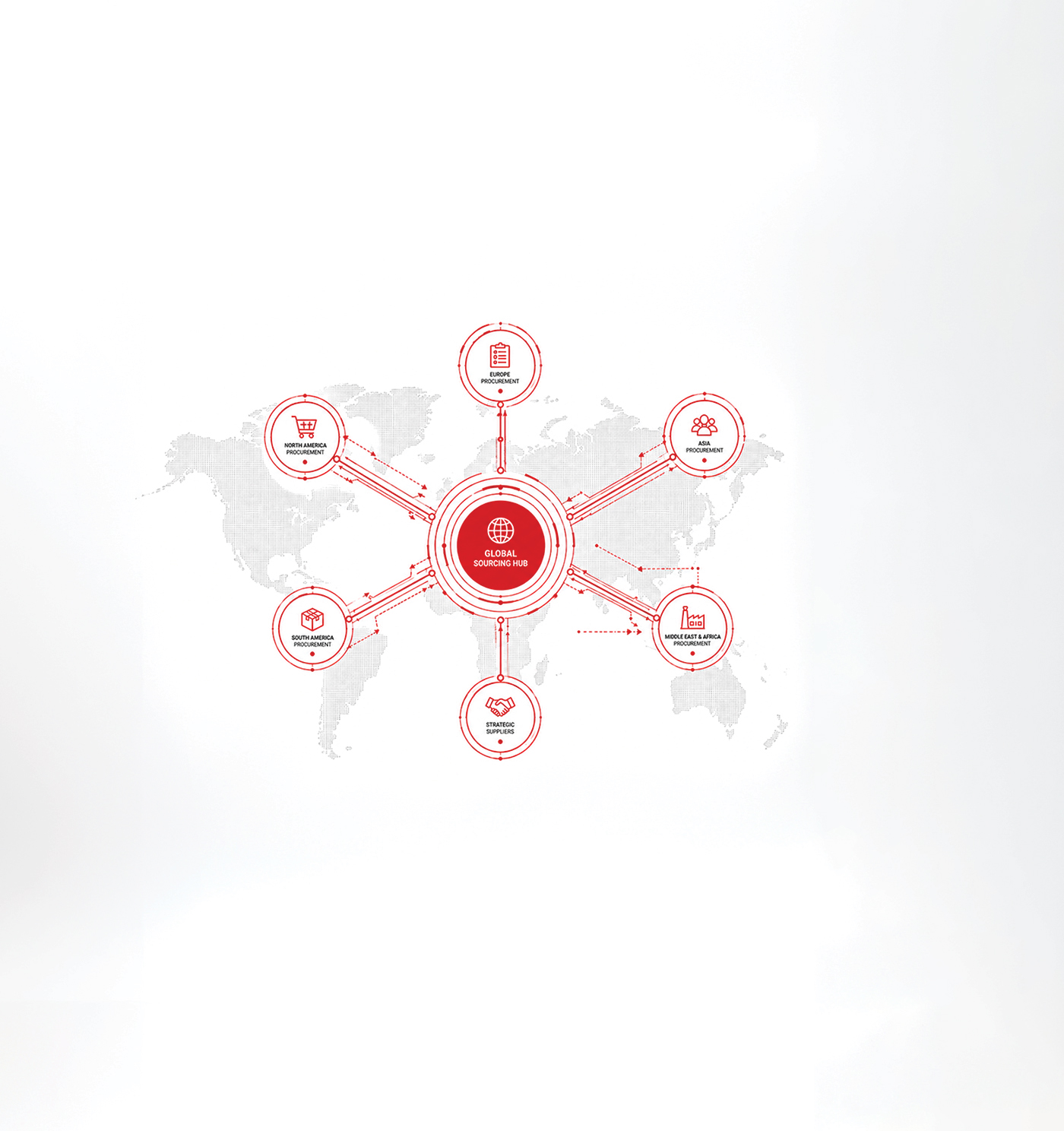
Junish sits between material supply and packaging performance, sourcing specialised films, foils and pre-laminated structures from multiple locations worldwide as a single point of contact for the category. [22]
That position matters because good foil sourcing is a matching exercise: foil to laminate, laminate to converter, converter to filling line, finished pack to the destination market’s regulatory and end-of-life requirements. Junish’s own range, which includes ultra-light-gauge foil in alloys 8079, 8011 and 1235 and foil-plus-PE-extrusion-coating structures, sits directly inside that matching problem. [14, 16]
Junish does not promise that every structure is automatically sustainable or compliant. It helps customers ask the right questions, source the right material route, and validate the right structure for the application at hand.
India’s opportunity is structural, but it must be earned
Indian aluminium foil is getting harder for global flexible-packaging buyers to ignore. The industrial base is real, the export channels are already open, and the direction of travel is upward across capacity, production and trade reach. [4-8]
That opportunity still has to be earned. The Indian-origin foil propositions that win will be built on consistent gauge control, pinhole performance, convertibility, traceability, logistics reliability and carbon data that can survive scrutiny, not on price.
Treat Indian aluminium foil as a strategic component of a resilient, technically governed, environmentally accountable packaging portfolio rather than a tactical substitute, and its structural importance becomes the obvious conclusion rather than a claim that needs defending.
This is where Junish creates value: connecting manufacturing capability, material knowledge and application requirements into packaging solutions that hold up in the real world.
References
All source links below are included for verification and publication support. Figures in the article are rounded from the cited source data.
[1] World Bank WITS / UN Comtrade — China exports, HS 760711, 2024
[2] World Bank WITS / UN Comtrade — China exports, HS 760719, 2024
[3] World Bank WITS / UN Comtrade — China exports, HS 760720, 2024
[4] World Bank WITS / UN Comtrade — India exports, HS 760711, 2024
[5] World Bank WITS / UN Comtrade — India exports, HS 760719, 2024
[6] World Bank WITS / UN Comtrade — India exports, HS 760720, 2024
[7] Government of India, Ministry of Mines — Monthly Summary on Minerals and Non-ferrous Metals, March 2026
[8] Directorate General of Trade Remedies — Final Findings: Aluminium Foil up to 80 micron from China PR, 20 March 2025
[9] World Bank WITS / UN Comtrade — India exports, HS 760711, 2023
[10] World Bank WITS / UN Comtrade — India exports, HS 760719, 2023
[11] World Bank WITS / UN Comtrade — India exports, HS 760720, 2023
[12] Government of India, Ministry of Finance — Notification No. 15/2025-Customs (ADD), aluminium foil from China
https://info.eepcindia.org/files/1750755924.pdf
[13] ASTM B479 — Standard Specification for Annealed Aluminum and Aluminum-Alloy Foil for Flexible Barrier, Food Contact, and Other Applications
[14] Junish — Ultra Light Gauge Foil
[15] ASTM B926 — Standard Method for Pinhole Determination in Aluminum and Aluminum Alloy Plain Foil by Means of a Light Table
[16] Junish — Aluminium Foil + PE Extrusion Coating
[17] NITI Aayog — Roadmap for Aluminium Sector Decarbonisation
https://niti.gov.in/sites/default/files/2026-01/Roadmap_for_Aluminium_Sector_Decarbonisation.pdf
[18] European Commission — Packaging Waste and Packaging and Packaging Waste Regulation overview
[19] European Commission — Carbon Border Adjustment Mechanism overview
[20] European Commission — CBAM guidance for EU importers; aluminium products list including CN 7607
[21] Aluminium Stewardship Initiative — ASI Standards overview
[22] Junish — Company and product positioning