Aluminum Foil Laminates for Food and Pharma Packaging: Barrier Properties, Lidding Options and What to Look for in a Supplier
If you’ve ever opened a yoghurt cup, popped a tablet out of a blister pack, or torn open a snack pouch, you’ve handled a foil laminate. You probably didn’t think about it. That’s rather the point. When foil packaging does its job, nobody notices it. When it fails, everybody does: the biscuits go soft, the tablet loses potency, the seal leaks in transit.
If you’re a converter or brand owner choosing materials, that quiet reliability is exactly what you’re paying for. So let’s look at why aluminum foil works so well, where it fits in food and pharma packaging, and how to pick a supplier who will actually support you when something goes wrong.
Why foil is still the barrier benchmark
Most packaging films let a little something through. Oxygen creeps in, moisture drifts across, light gets in and degrades the contents. Plastics can slow this down, but foil, when it’s thick enough and well made, is close to a complete barrier against oxygen, water vapour, light and aroma loss.
That matters because those four things are what spoil products:
- Oxygen drives oxidation, rancidity and loss of potency.
- Moisture softens crisp foods, clumps powders and degrades moisture-sensitive drugs.
- Light breaks down vitamins, fats and some active ingredients.
- Aroma loss flattens flavour in coffee, spices and ready meals.
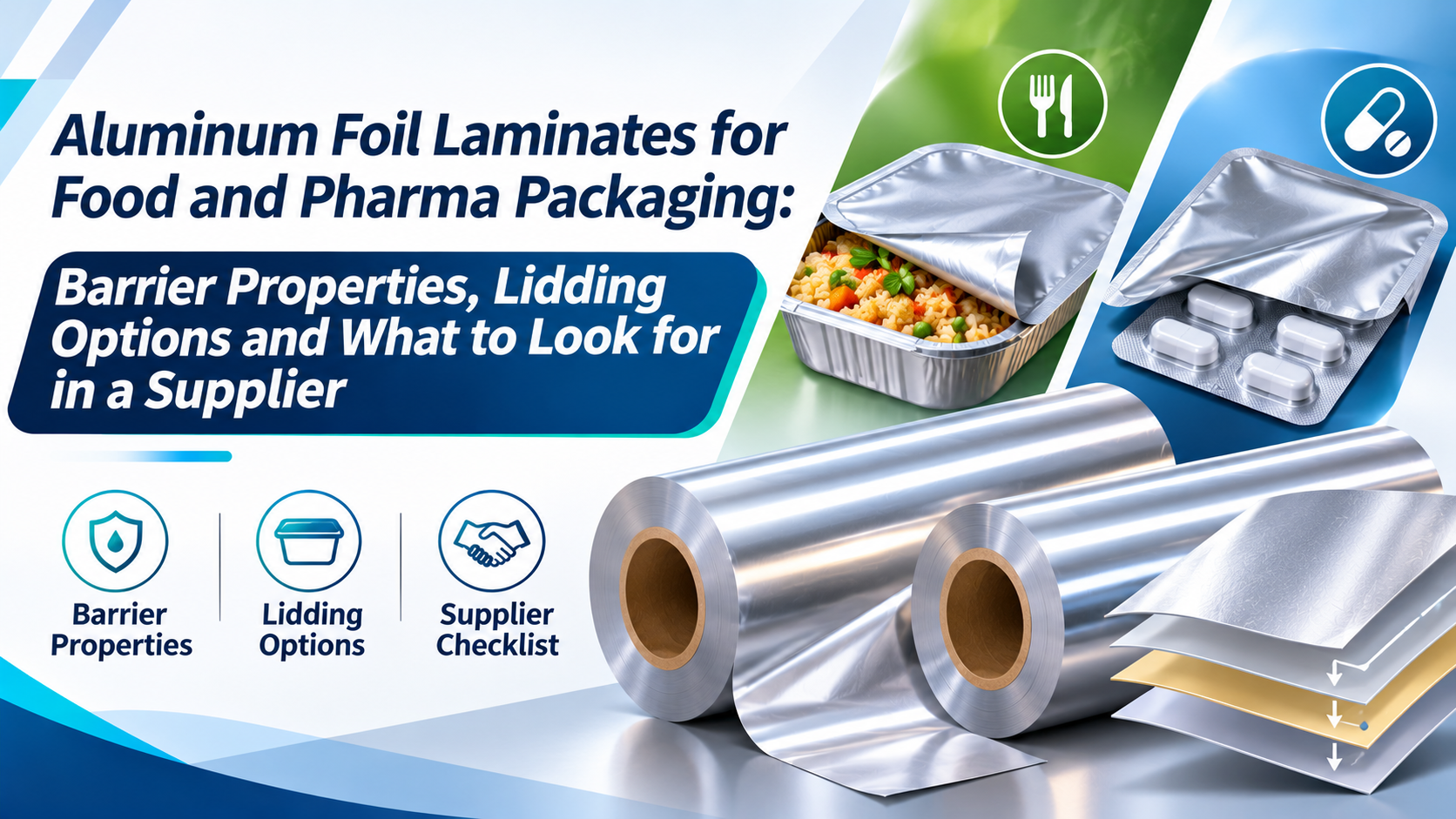
Foil on its own is rarely the whole answer, though. It’s thin, it can crease, and it can’t be heat sealed by itself. That’s why it’s usually laminated to other layers such as polyester, nylon or polyethylene, each adding strength, printability or sealability. The skill is in designing the structure, not just picking “foil”.
Food packaging: where foil lidding earns its place
Lidding is one of the clearest examples of foil doing real work. Think of yoghurt pots, dairy desserts, ready meals, pet food trays and portion packs. The lid has to seal cleanly to the container, survive filling and distribution, and still open without a fight when the customer wants it.
A few things to check on a lidding spec:
- Seal compatibility. The sealing layer has to match your container material, whether that’s PP, PS, PET or something else. A mismatch means weak seals or seals that are too strong to peel.
- Peel behaviour. Some applications want a clean peel, others a permanent seal. Be clear about which you need before you ask for samples.
- Print and surface finish. If the lid carries branding, check how well the outer surface takes ink and whether it will survive your line.
- Processing conditions. Hot fill, retort and pasteurisation put very different demands on a laminate.
Junish’s lidding range is aimed at exactly these food uses: protection, presentation and preservation. If you’re comparing options, it’s a useful reference for the kinds of structures available.
Pharma packaging: where there’s no room for error
Food spoils. Drugs can stop working. That’s why pharmaceutical packaging is held to a tougher standard, and why foil shows up so often there, especially in blister packs and strip packs.
In pharma, the things you’ll weigh up include:
- Barrier performance. Moisture and oxygen resistance directly affect shelf life. Cold-form foil laminates are popular for the most sensitive products because they deliver very high barrier protection.
- Chemical resistance. The laminate must not react with, or absorb from, the product inside.
- Consistency from batch to batch. A drug that’s stable in one lot of packaging and not in the next is a regulatory headache.
- Documentation. Pharma buyers need traceability and clear specifications, not just a good sample.
Junish lists pharmaceutical solutions built around lightness, moisture and chemical resistance, and strong oxygen barrier properties, which are the qualities pharma teams ask about first.
How to actually read a foil spec sheet
Spec sheets can look like alphabet soup. Here’s a plain-language way through them.
Thickness. Foil gauge is measured in microns. Thinner foils are cheaper and lighter but can have more pinholes, which weakens the barrier. Thicker foils perform better but cost more and can be harder to form. Match the gauge to how sensitive your product is.
Structure. Laminates are written as a stack of layers, for example PET / foil / PE. Each layer has a job: the outer layer for print and strength, the foil for barrier, the inner layer for sealing. Ask your supplier why each layer is there. A good one will explain without hesitation.
Sealant type. This decides what the material will seal to and at what temperature. It’s where many line problems start.
Tolerances. Small variations in thickness or width can cause big problems on a high-speed machine. Ask what tolerances the supplier works to and how they check them.
If you want to sanity check your roll sizes and weights while you plan, Junish has a free roll weight and length calculator that saves some tedious arithmetic.
What to look for in a foil supplier
The material matters, but so does who’s behind it. Here are the questions worth asking before you commit.
1. Do they understand converting, not just selling?
A supplier with a manufacturing background will anticipate how a laminate behaves on your machine. That saves trial runs and wasted material. Junish says it draws on decades of manufacturing experience and works with customers’ engineers, which is the kind of technical conversation you want.
2. Can they source flexibly?
Single-source supply is risky. A supplier who buys from several places worldwide can often find an alternative when capacity tightens or prices move.
3. How do they handle lead times?
Overseas pricing is attractive until the container is late. Local warehousing and consignment programs can give you the best of both: competitive pricing and domestic delivery speed. It’s worth asking how a supplier’s stocking model would work for your volumes.
4. Who do you call when something goes wrong?
This is the question people forget. Having a named contact who responds quickly matters far more than a glossy brochure. Junish highlights a dedicated client services role to handle support from first enquiry through to after-sales issues.
5. Can they customise?
Standard structures don’t suit every product. If you have an unusual shelf-life target, machine, or regulatory requirement, ask whether the supplier will work with you on a tailored solution. Their specialised solutions category is built around that kind of collaboration.
6. Are they thinking about sustainability?
Brand owners are under pressure to reduce waste. Even if foil isn’t going away, it’s worth asking about recycled-content films and mono-material alternatives where they make sense. Junish’s sustainable solutions include films with recycled content and compostable options.
A simple way to start
You don’t need to overhaul your sourcing in one go. A sensible first step looks like this:
- Write down your product’s real needs: shelf life, sensitivity, filling method, seal type.
- Ask two or three suppliers for samples and full technical data sheets.
- Run those samples on your actual line, not just in a lab.
- Compare not just price per kilo, but waste, downtime and how helpful the supplier was along the way.
The cheapest roll is rarely the cheapest outcome. A slightly dearer material that runs cleanly and protects your product will usually win on total cost.
Final thoughts
Aluminum foil laminates earn their place in food and pharma packaging because they protect what’s inside, reliably and for a long time. But the right material is only half the story. The other half is a supplier who understands your process, supports you when the unexpected happens, and gives you consistent quality shipment after shipment.
If you’re exploring options, you can browse Junish’s full product range or get in touch with the team to talk through your application.